
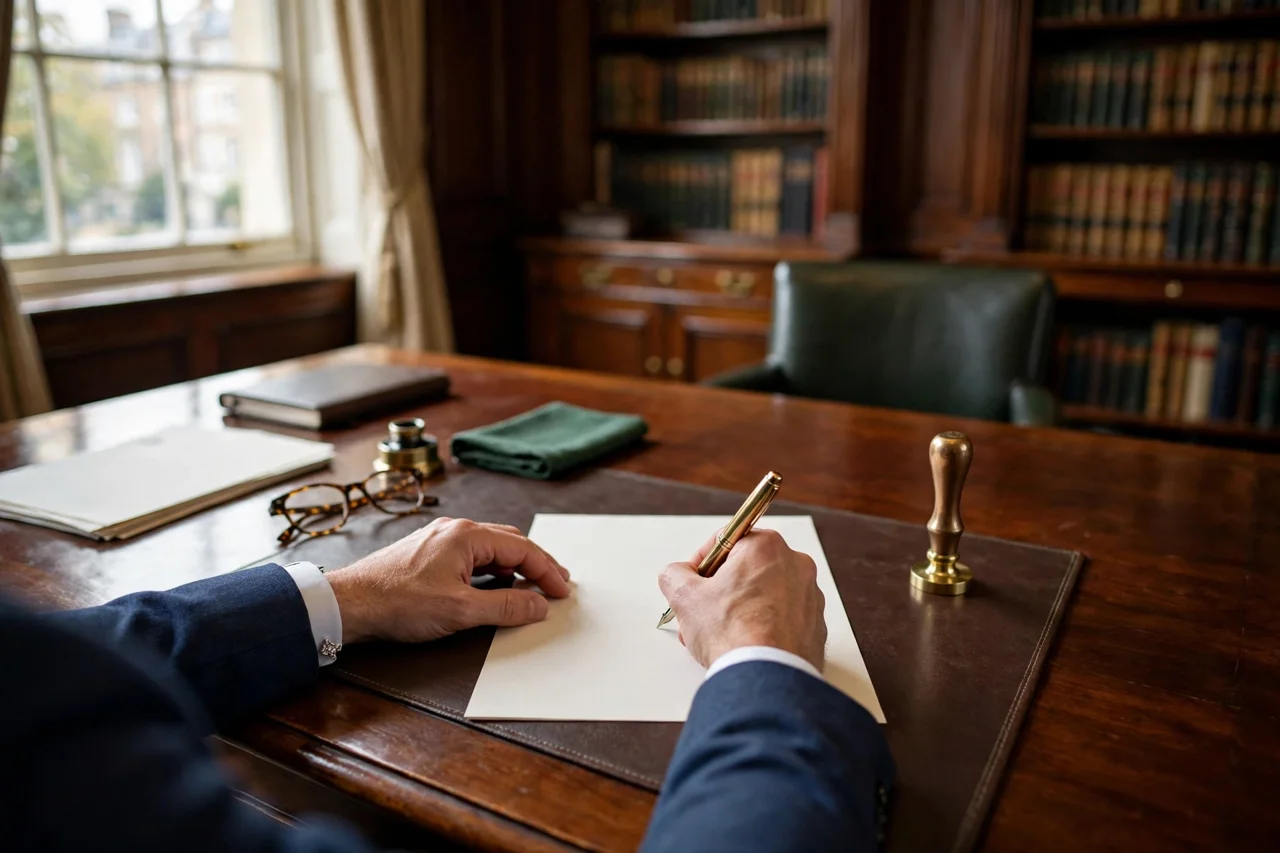

Most people go through life without ever needing a notary public, until one day a bank, a foreign authority or a property sale abroad insists on one. At that point the questions come quickly: what exactly is a notary, how is the role different from a solicitor, and which documents actually need notarising? In England and Wales, notaries are a distinct and very old branch of the legal profession, regulated separately from solicitors and barristers. This guide explains what a notary public does, the situations where you are most likely to need one, and how to prepare for an appointment so the process goes smoothly the first time.
What Is a Notary Public?
A notary public is a qualified legal officer whose role is to authenticate documents and transactions so that they will be accepted, usually by authorities and institutions in other countries. When a notary signs and seals a document, they are certifying matters such as the identity of the person who signed it, that the signature was made willingly in their presence, and in some cases that the contents are true to the best of the signer’s knowledge. The notary’s seal carries weight internationally precisely because notaries are independent, regulated and required to verify what they certify rather than simply witness a signature.
In England and Wales, notaries are regulated by the Faculty Office of the Archbishop of Canterbury, a survival of the profession’s centuries-old history. Many notaries are also solicitors, but the two roles are separate: a solicitor acts in their client’s interests, while a notary acts impartially to certify facts for the benefit of everyone who will rely on the document. If you are unsure which professional you need for a particular task, our guide on how to choose a solicitor in the UK explains the solicitor’s role in more detail, and our overview of law firm structure in the UK shows how the different legal roles fit together.
When Do You Need a Notary Public?
Buying or selling property abroad
Foreign property transactions are one of the most common reasons people visit a notary. Powers of attorney authorising a lawyer overseas to complete the purchase, mortgage documents and declarations often have to be signed in front of a UK notary before the foreign land registry or bank will accept them. The process has some similarities to the checks involved in a domestic purchase, which our guide to conveyancing and the legal process of buying a house explains step by step.
Documents for use overseas
Notaries regularly certify copies of passports, educational certificates, marriage certificates and company documents for foreign employers, universities, banks and immigration authorities. If you are marrying abroad, working overseas, adopting internationally or opening a foreign bank account, there is a good chance a notarised document will be on the checklist.
Swearing affidavits and statutory declarations
A notary can administer oaths and take affidavits and statutory declarations for use in foreign court proceedings, and can certify the execution of documents by companies, including verifying that the person signing has the authority to bind the company. Notaries also deal with ship protests, bills of exchange and other specialist work that rarely crosses a solicitor’s desk.
Wills and estates with foreign assets
If an estate includes assets in another country, the executors may need notarised documents to deal with foreign banks and registries. This sits alongside the domestic process described in our guide on how to write a will in the UK, and it is one reason people with property or accounts abroad are advised to plan their paperwork early.
Apostille and Legalisation
Notarisation is sometimes only the first step. Many countries also require an apostille, a certificate issued by the UK Foreign, Commonwealth and Development Office that confirms the notary’s signature and seal are genuine. Some countries that are not part of the Hague Apostille Convention require full legalisation through their embassy instead. Your notary will normally advise which route your document needs and can often arrange the apostille for you. Build the extra time into your plans: a document needed for a deadline abroad should start its journey days or weeks ahead, not the night before.
What Happens at a Notary Appointment?
The notary must verify your identity, usually with a passport or driving licence plus a recent proof of address, and must be satisfied that you understand the document and are signing voluntarily. For company documents, they will check registers and may require evidence of the directors’ authority. Bring the complete document, unsigned, together with any instructions you received from the foreign lawyer or authority requesting it. If the document is in a language you do not read, tell the notary in advance; they may need a translation or may decline to certify something the signer cannot understand.
Fees are agreed with the notary directly and depend on the number and complexity of the documents, with extra charges for apostille or legalisation where needed. Because notaries must keep detailed records and follow strict practice rules, the appointment is formal, but for a prepared client it is usually quick.
Final Thoughts
A notary public is the legal system’s bridge between the UK and the rest of the world: an independent officer whose signature and seal make documents trustworthy across borders. You are most likely to need one for property abroad, work or study overseas, foreign court matters, or estates with international assets. Check early what your foreign lawyer or authority requires, bring the right identification, and leave time for an apostille if one is needed. For more plain-English explanations of UK legal processes, browse our legal advice and professional services guides, including our overview of practical legal resources and research tools.
